



























Understanding Your Female Student’s Background
When beginning to instruct a new female student, there are many things to take into consideration before she gets her first pistol in her hands.
Important Considerations
Some things to consider would be has she been a victim of assault whether physical or sexual, has she been a witness to a crime either a friend/family member or a stranger(s), has she had a previous bad experience around firearms, has she already tried to shoot a firearm, but it was a firearm not suited for her and now she’s afraid…
There can be other instances that have not been mentioned here as well, so keep an open mind. If she has not had any negative experiences, then you’re well on your way to opening up a whole new world of training/education whether it is self-defense, competition, recreation, sisterhood or curiosity.
Building Trust and Safety
Gaining her trust and ensuring her that she will be safe is most imperative. So how do we go about getting this accomplished?
Step 1: Have an Open Conversation
First, just have an open conversation with her about her “why” in wanting to learn. Listen intently for some things she may not be saying, but is trying to tell you. Listen without judgement and let her tell her story. We all have that story that prompted us to begin that special journey.
Step 2: Clarify Her Goals
Secondly, clarify what she is expressing to you to make sure you understood her correctly.
Step 3: Provide Reassurance
Thirdly, reassure her that she is not alone in wanting to begin a journey learning about firearms. Her “why” may change and/or grow into something else as she’s telling her story.
Managing Emotional and Mental Aspects
The emotional and mental aspects are more than half the battle she will face. Ease the tension, nervousness, anxiety and fear by providing an environment that is safe and not overly crowded.
Creating the Right Learning Environment
Ideally having a place where there are not a lot of people so she won’t feel so self-conscious not able to focus. Educating her on the basic anatomy of her firearm can help reduce some anxiety. As we know, knowledge is power. You want her to gain the feeling of being empowered as she is learning.
Teaching Techniques
Speak calmly, slowly and clearly as she is learning this new language. Assess her learning by asking her to rename the basic parts of her firearm.
Safety Training
Spend some solid time on safety – safety rules at the range, safety rules at home, safety rules in a vehicle, and safety rules in public.

Managing Your Own Emotional Quotient
Remember, you will need to access and pay attention to your own Emotional Quotient (EQ) as well. If you’re too hyped up or too demanding, that flows over to her potentially affecting her learning.
Hands-On Training and Dry Fire Practice
Assess if she is ready to continue or if she has had enough for one session. If she has had enough and feeling overwhelmed, schedule a follow up session with her soon.
If she is ready to continue, start with her handling her firearm while keeping all the safety rules in place. Teach her how to rack the slide in a way that fits her anatomy and level of strength if using a semi-auto pistol.
The Importance of Dry Fire
Teach her about the basic fundamentals of shooting beginning with dry fire. Let her get comfortable with those newly learned skills before moving too quickly to live fire. Dry fire is a great place to spend a good amount of time to allow her to get really comfortable and build confidence.

Proper Equipment and Attire
When you both feel ready to move to the next phase of learning, having proper personal protective equipment (PPE) and attire are essential.
Personal Protective Equipment
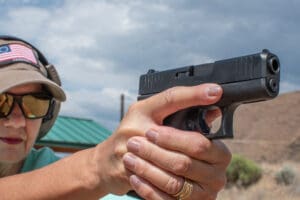
Proper fitting hearing and eye protection can make a big different in a person being able to give their full attention to learning and not worrying about how uncomfortable something is feeling. This can be a distraction and create unnecessary worry.
Clothing Considerations for Women
Proper attire is not only important for everyone, but especially for ladies since our clothing is much different from men’s. Ladies clothing tends to have more v-necks and lower cut styles than men’s clothing. Comfortable close-toed footwear is a game maker or breaker.
Moving to Live Fire
You’ve come to this part of her training and education and she is ready to perform live fire. Again, manage your EQ and assess and manage hers to see if more discussion needs to take place regarding something previous learned that she is feeling uncertain about.

Demonstrating Proper Technique
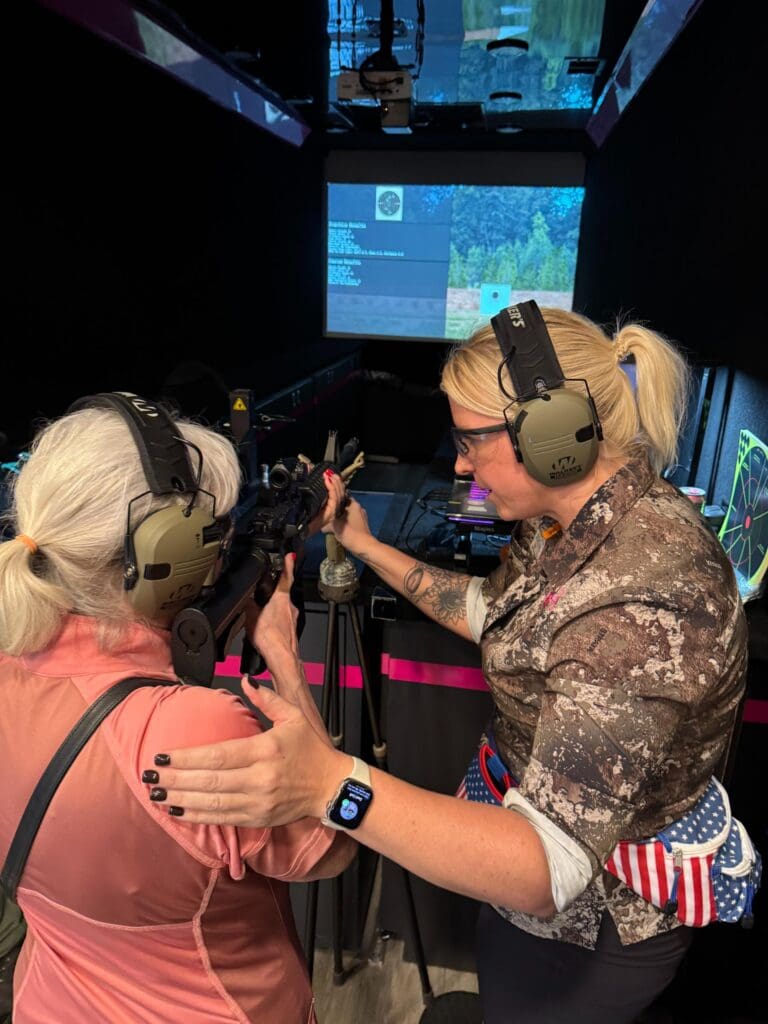
You will want to demonstrate slowly and methodically what you will be asking her to perform. Allow her to ask questions to ensure she clearly understands what is expected of her. Let her know that you do not expect perfection.
Building Confidence During First Shots
This is a delicate time that could build or break her confidence. Try not to rush or push her too quickly. Allow her to go at her pace. If she has been previously traumatized by an incident and is very nervous, you might want to ask her permission if you can place your shooting hand on top of her shooting hand and finger to press the trigger on her first shot.
Progressive Training Approach
Begin with one round at a time and progress from there according to her comfort level. Give her positive feedback no matter where the shot landed on the target.
Target Selection
Start close up with targets that are very simplified such as a blank white 8in x 11in sheet of paper or larger or just the target backer with no lines or images.
Process Over Outcome
You want her to become processed focused and not outcome focused. We all know this can be a bit of a challenge as we all have battled with this from time to time. Continue to give positive feedback throughout her learning session. The focus here is safety and building good fundamentals as well as building her confidence.
Building Long-Term Success
As she builds her confidence and begins to feel empowered, encourage her to schedule another session with you after you’ve completed this one.
Listen to her feedback of the good, not so good, and ugly and make changes as necessary to fit her learning style and to manage her EQ. Praise her for her hard work.
Continuous Improvement for Instructors
Then ask yourself, “What did I learn from this student and how can I do better as an instructor?” You might surprise yourself in what you’ve learned from her. As an instruction, your own learning never stops either.
Besides, it just FUN!!! Let’s go shoot!